




The Feb 15 Show

Freight, Fire, and the Long Summer Between

By mid-February the country is no longer easing into the year. It is properly back at work. Trucks are running full schedules again. Agricultural shows are back on the calendar. Fire recovery has moved from emergency response to long-term repair. And the conversations feel less like holiday reflections and more like people taking stock.

This week’s calls moved carefully between memory, labour, weather and the small details that anchor a community.

Albury and the Road That Keeps Moving

Ron Fennimore was somewhere between Gunning and Goulburn when he rang. Eleven trucks under his management. Hay, cattle, general freight. The kind of fleet that keeps regional Australia supplied without much notice.

He had been in Albury the day before for the memorial of Max Luff.

Max, Ron said, was not just another operator. Founder of Border Express in 1981. A man who built a national freight company from the border country and remained connected to the region that shaped him. A significant supporter of the Albury Wodonga Regional Cancer Centre Trust.

Ron spoke about the turnout first. Drivers rearranging runs to attend. Trucks parked along the street. Old hands and young operators in the same room. In transport, reputation is everything. You either pay on time, honour your word and stand by people, or you do not last.

He described the service as packed. That, in his world, was the measure. Respect is counted in attendance.

Then he was back behind the wheel, southbound again.

Volunteers in the Ash

Robin from Boronia shifted the tone. She had been involved with four-wheel drive clubs heading into fire-affected areas around Fawcett and Yarck.

The fires were no longer front-page news, but the damage remained. Fence lines reduced to twisted wire. Star pickets bent. Access tracks washed out or blocked by fallen timber. Farmers still tallying stock losses.

The clubs were bringing trailers, tools and time. Clearing debris. Rebuilding fences. Helping with the jobs that are too big for one person but too small to attract formal funding.

Robin described the rhythm of it. Early starts. Shared lunches on tailgates. Listening while landholders talk through what they have lost and what they plan to rebuild. Recovery, she said, is not a single moment. It is cumulative.

The work is practical. The effect is often emotional.

Gundagai and the Show Ring

Jim rang from Gundagai where the annual show was underway in full heat.

He painted the scene carefully. Horses circling in the ring. Pavilion tables lined with jars of preserves and carefully folded knitting. Woodchop events drawing a steady crowd. Kids leading calves through dust under a wide sky.

Shows, he said, are not nostalgia. They are continuity. No matter what the season has delivered — drought, flood, low prices — the show goes on.

There was pride in the way he described the committee’s effort. Entries were strong. The district had turned out. The sound of generators and loudspeakers carried across the grounds.

In uncertain seasons, routine can feel like stability.

Beef, Receipts and the Supermarket Question

Andrew’s call moved into the economics of the kitchen table.

He had recently returned from Japan and observed how Australian beef is marketed there — presented as premium, priced accordingly, carefully displayed. Back home, he had been comparing prices at Coles and Woolworths, noting identical pricing across multiple items.

He questioned whether farmers were receiving fair returns and whether supermarket margins were narrowing competition. The discussion moved through export dynamics and domestic supply chains. Macca pressed him on where value is captured.

Andrew’s tone was measured rather than heated. It was about transparency. About wanting clarity in a system that feels increasingly complex.

The weekly grocery bill, he implied, is becoming a point of scrutiny.

Surf Boats at Wanda

From economics to the beach.

The Australian Surf Rowers League carnival at Wanda Surf Life Saving Club was in full swing. Crews lined up at the water’s edge. Oars raised. Sweeps calling timing against the incoming sets.

Surf boat rowing is technical and physical. Five rowers and one sweep must move as a single unit. The sets at Wanda were clean but demanding. The caller described the tension at the start line, the split-second timing required to catch a wave cleanly.

There was pride in the discipline. Early training sessions. Travel between states. Families on the sand watching closely. The culture of surf life saving running alongside competition.

The boats are heavy. The effort visible. The sport remains resolutely physical.

Cabargo and the Long After

A letter from near Cabargo carried the morning into deeper reflection.

The writer described properties around Wandella and Yowrie, on the edge of Wadbilliga National Park, still carrying the imprint of the Black Summer fires. Some homes rebuilt. Others not. Insurance negotiations stretched over years. Fences replaced slowly.

The detail was specific. The way certain gullies burned hotter. The speed at which the wind changed direction. The silence afterward.

Recovery, the writer suggested, does not follow a timetable. Bush regenerates unevenly. People do too.

The tone was steady, not dramatic. That made it more affecting.

Looking Up from Coonabarabran

Dr Duncan Steele shifted the lens skyward.

From observatories near Coonabarabran, astronomers study the southern sky — the Magellanic Clouds, Alpha and Beta Centauri. He spoke about long orbital cycles and Milankovitch theory, about how planetary patterns influence climate over vast stretches of time.

It was not an attempt to dismiss present-day concerns. It was about scale. Human debates sit within much larger cycles.

Looking up, he suggested, can steady perspective.

Snowfields and Changing Winters

The conversation turned briefly to the alpine resorts — Thredbo and Perisher — and the variability of snow seasons. Businesses reliant on winter tourism watching forecasts closely.

There was no dramatic claim, just recognition that adaptation may be required. Seasonal industries have always lived with uncertainty. The margins, perhaps, feel tighter now.

Holding the Threads Together

By the time the calls slowed, the map had stretched again.

From a memorial hall in Albury to burnt paddocks in Victoria. From show rings in Gundagai to surf boats at Wanda. From supermarket aisles to observatories under clear country skies.

Freight still moves. Volunteers still turn up. Shows still open their gates. Families still read their receipts carefully. The sky remains where it has always been.

For a few hours on a Sunday morning, those threads are spoken aloud.

Listen to the podcast episode here.

Disclaimer:Australia All Over’ is a program produced and broadcast by the ABC Local Radio Network and hosted by Ian McNamara. Brisbane Suburbs Online News has no affiliation with Ian McNamara, the ABC, or the ‘Australia All Over’ program. This weekly review is an independent summary based on publicly available episodes. All original content and recordings remain the property of the ABC. Our summaries are written in our own words and are intended for commentary and review purposes only. Readers can listen to the full episodes via the official ABC platforms.

The Feb 8 Show

Ore Trains, Ocean Crossings and the Long View of Summer

There is a particular texture to a February morning on the program. The holidays are over. The heat has settled in properly. Fires are burning in one state while another waits for rain. People are back at work, back on highways, back in boats and on beaches, carrying the season with them.

This week the lines stretched from the red dirt of Western Australia to the cold valleys of Utah, from Bass Strait crossings to million-dollar race wins, from seedless pumpkins to the first steps on the Moon.

Australia, as ever, was wide awake.

One Hundred and Forty Tonnes Before Dawn

Craig was somewhere between Wiluna and Leonora, running south along the Goldfields Highway with 140 tonnes of iron ore behind him. All up, he said, the rig weighs about 195 tonnes. It was still dark. Thirty degrees already. Cows wandering across the road.

He works fly-in fly-out. Four weeks on, two weeks off. A month at a time in the West, then home to the Gulf for a break. Twelve-hour shifts, sometimes twelve and a half. This was the last run of his swing before flying out on Monday.

Out there, the traffic is mostly other road trains and mine vehicles. Not much else. No suburban rush hour. No coffee queues. Just heat that sits in the cab and the long ribbon of bitumen through scrub.

When asked what he could see out the window, the answer was simple: bush, darkness, and the need to stay alert for livestock. With that much weight behind you, you do not get second chances.

Three Kayaks and 320 Kilometres of Water

Photo Credit: Visit Victoria

From the open highway to open ocean.

David rang from Roydon Island, just off the northern tip of Flinders Island in Bass Strait. He and two friends call themselves the Strait Crackers. They had launched from Port Welshpool, paddled to Wilsons Promontory, sheltered in Refuge Cove, then crossed to Hogan Island, on to Deal Island, and down toward Flinders.

Three exposed crossings. Around 320 kilometres in total. About two weeks on the water, depending on the weather.

They carry freeze-dried meals, water, beacons, plan A, B and C. They wait for weather windows and do not launch if the forecast looks wrong. “You’d be crazy,” he said.

Their longest crossing had been 65 kilometres. Tailwinds at times, small sails up, some “spicy moments” but nothing unmanageable. The trick is respect. If it turns, you hold ground, ride it out, reassess.

David is an outdoor education teacher in Kangaroo Valley. Every few years he plans something bigger than routine. One of his teammates, Paul McMahon, is an apple farmer in Pozieres near Stanthorpe. Apple season is underway. The crates are being packed while he is out on Bass Strait.

The destination now is Whitemark, and a pub. After weeks of salt, spray and rationed food, that sounded like a fitting reward.

A Horse Nearly Lost, Then Found

Des rang with the kind of excitement that comes only rarely.

His horse, Axius, had nearly been put down as a foal after suffering a broken jaw from another horse. Instead, he survived. Carefully managed. Lightly raced. Five wins from nine starts.

They took him to the Gold Coast, almost as an afterthought, for a three and four-year-old race. He ran third, carrying 60 kilos with Nash Rawiller aboard. A week later they had a throw at the stumps in a much harder race. Des managed to get odds of 100 to one early in the week, not even sure the horse would gain a start.

He did. He won.

A million-dollar race. Trained by Kieran Ma, largely prepared out of Bong Bong by Johann Gerard-Dubord, ridden this time by Tim Clark. Prize money of $579,000 for the win. Des owns five per cent.

He described it not as triumph, but gratitude. “More thankful than excited,” he said. There was no jealousy among friends and family. Just delight.

The horse now heads toward listed and group races. For Des, it already feels like the Melbourne Cup.

Honeysuckle Creek and the First Steps

Michael rang from Kiama to clarify something that matters to those who remember July 1969.

It was Honeysuckle Creek Tracking Station, near Canberra, that first received and broadcast Neil Armstrong’s descent onto the Moon and the first minutes on the lunar surface. Not Parkes, at least not initially.

The camera on the lunar module had been installed upside down. Engineers at Honeysuckle Creek worked out how to invert the signal properly before transmission. Later the dish was relocated to Tidbinbilla. Today there is a plaque marking where those first images were sent to the world.

It is the kind of detail that sits quietly in Australian history. Not flashy. Just precise.

Rates, Debt and a Drought in Utah

Kieran Kelly joined from Utah, sitting in sunshine where there should have been four feet of snow.

He spoke first about interest rates. A quarter of a percent rise, he argued, is symbolic rather than decisive. He recalled Paul Keating’s idea of the “announcement effect” — shock the system to change behaviour. One per cent in a single hit would send a clearer message than incremental adjustments.

Australia’s national debt is heading toward $1 trillion. The interest bill alone about $27 billion this year. That, he warned, is a burden passed forward.

Then he looked out his window.

In the Wasatch Mountains, mid-winter, there was no snow. Ten degrees and sunbathing weather. Golf courses open. Deer grazing on lawns normally buried under drifts. The lowest precipitation in fifty years.

Photo Credit: Wikipedia

He described it in Australian terms: like Darwin passing through an entire wet season without rain. No build-up storms. No monsoon. Just dry heat rolling on.

Insurance companies are refusing fire cover in parts of the valley. Timber houses sit among trees. Businesses that rely on ski tourism are struggling. Even whispers about future Olympic viability.

The drought there is not dramatic in the way floods are. It is simply absence.

Sharks, Science and Caution

Back home, the shark discussion continued. Bull sharks in Sydney Harbour are not new. What seems new is their apparent increase in attacks.

Water temperature shifts, turbidity after heavy rain, changing prey patterns — there are theories, but no consensus. A paramedic from the Mid-North Coast called to clarify the practicalities: in a shark bite, the immediate priority is catastrophic bleeding control. Tourniquets save lives. But so does keeping the patient warm. Hypothermia impairs clotting.

It was a reminder that debate sits alongside real people dealing with consequences.

At Bondi, the North Bondi Ocean Swim Classic went ahead. Other swims had been postponed. Swimmers will always return to the water.

Seedless Fruit and Seeded Doubts

Wendy from Stanley in Victoria wondered aloud whether seedless pumpkins and zucchinis signalled something deeper. She had seen crops without seeds, watermelons bred for convenience, strawberries that do not produce runners.

Was diversity being narrowed too far?

A horticulturist from Ballarat reassured her. Stress, poor pollination, extreme heat can all disrupt seed formation. It does not mean vegetables are disappearing. Plants still want to reproduce.

Still, the conversation drifted to grandparents’ gardens. Rhubarb, spuds, apricots, quinces. The memory of abundance grown at home rather than bought at supermarket prices.

In an era of rising costs, the backyard patch feels less nostalgic and more practical.

Letters from Santa Barbara and Beyond

Chris Morris wrote from Santa Barbara. As a boy he had grown up in Woomera, his first girlfriend the daughter of a US Air Force master sergeant stationed at Nurrungar Tracking Station near Island Lagoon.

Forty-six years later, he searched her name online. Found her. Flew to California. They married during COVID in a government-run ceremony conducted from a toll booth in Anaheim, with three minutes allowed for photographs before the next couple arrived.

Marriage in a car park. First love rediscovered. The world is stranger and kinder than it sometimes appears.

Jude and Judd wrote of 388 days without electricity on a small farm outside Perth. An outdoor shower bolted to a bush pole. Solar panels eventually installed. Eight years without television. ABC radio as companion.

There are many ways to live.

Patches and Persistence

Jennifer from Kings Langley spoke of sewing patches onto her trousers and shirts, making shopping bags from old drapes, wearing clothes decades old.

Her father once turned worn woollen skirts into overalls on a treadle machine. Waste, she said, is the real problem.

In a week of discussions about debt, drought and disappearing snow, there was something grounding in the act of mending what you already have.

Holding the Line

From iron ore trucks before dawn to kayaks on Bass Strait, from racehorse miracles to Moon landing corrections, from Utah drought to backyard vegetables, the morning held together through detail.

The country is not one story. It is thousands of them, overlapping.

Drivers watching for cattle at 30 degrees in the dark. Teachers paddling toward Whitemark. Owners checking racing results. Engineers correcting signals from space. Paramedics wrapping blankets around trauma patients. Gardeners worrying about seeds.

It is all happening at once.

And on a Sunday morning, for a few hours, it is all spoken aloud.

Listen to the podcast episode here.

Disclaimer:Australia All Over’ is a program produced and broadcast by the ABC Local Radio Network and hosted by Ian McNamara. Brisbane Suburbs Online News has no affiliation with Ian McNamara, the ABC, or the ‘Australia All Over’ program. This weekly review is an independent summary based on publicly available episodes. All original content and recordings remain the property of the ABC. Our summaries are written in our own words and are intended for commentary and review purposes only. Readers can listen to the full episodes via the official ABC platforms.

The Feb 1 Show

Heat, Memory and the Long Australian Road

By early February, the country is stretched thin. Heat lingers. Storms threaten. Rivers shrink in one place and swell in another. Fires burn on distant ridgelines. And when the phone lines open on a Sunday morning, what comes through is not outrage or spectacle, but the steady sound of Australians measuring the season in lived experience.

There are snowdrifts in Maine and minus twenty-six degree nights. There are forty-eight-degree kitchens in South Australia and cruise ships idling in Eden. There are blazes still active near Euroa and smoke hanging low over Newcastle. It is one of those mornings when the map feels restless.

From Rusutsu to Shark Beach

Dr Ian Francis rang from Sydney, just back from a trauma conference in Rusutsu, on Japan’s northern island of Hokkaido. A ski resort, he said, with a week of lectures and a little skiing folded in.

He had spoken to colleagues about recent shark attacks in Sydney. Not in abstract terms, but clinically. About arterial forceps. About blood loss. About the minutes that decide whether someone lives or dies. At one beach, he said, someone had opened a “shark bite kit” only to find a tourniquet, a phone number and a space blanket. The audience had laughed at the absurdity. The last thing you need, he said, is a space blanket. You need to stop the bleeding.

The conversation drifted to older habits. To swim inside enclosures. To be told as children never to venture beyond the net. On the Georges River, the fear had once been grey nurse sharks, now known to be largely sedentary and misunderstood. But the rule stood: do not swim where you are not protected.

The sea, it seems, remains indifferent to our confidence.

Nullarbor Skies and Mullamullang Cave

Photo Credit: OzGeology/YouTube

Bill rang from near the mouth of the Brisbane River, camped beside boat trailers and watching fishermen launch before sunrise. But his story belonged to the Nullarbor.

In the 1960s he had joined expeditions organised by the Sydney University Speleological Society. Through aerial photographs and long drives over limestone country, they located what was then known as the longest cave in Australia: Mullamullang Cave. They surveyed it to the one-mile peg before reaching a rock pile that seemed impassable. Later, others found the continuation. Bill returned and became one of the first to reach the end.

He described it as mountaineering underground. Vast passages rather than claustrophobic squeezes. Sand dunes inside the earth. A blind spider and a cave cockroach, one photographed and later catalogued.

Above ground, life continued across the same plain. He and his wife spent their first Christmas at Twilight Cove, south of Cocklebiddy, driving a Volkswagen Beetle along the beach. Sixty years together followed. Twenty-seven crossings of the Nullarbor. Standing at night beneath skies so wide they recalibrate your sense of scale.

He spoke of her passing three months ago, without drama. Just fact. The road, it seems, holds memory.

From Forty-One Degrees to Minus Forty-One

Jenny from Wonthaggi remembered leaving Victoria in forty-one degrees Celsius, shepherding eighteen Rotary exchange students through Los Angeles airport toward flights stretching from Alaska to Mexico.

Within days she was standing in snow at the Grand Canyon. Then in Thompson, Manitoba, at minus forty-one overnight. From heat that makes the bitumen shimmer to cold that freezes eyelashes.

She learned cross-country skiing in minus twenty. She said she would live there if she could. The extremes were less remarkable than the adjustment. The body, she implied, is adaptable. It is the shock of transition that lingers.

Back in Victoria, even a modest sprinkle of rain felt like relief.

Entangled off Tathra

Marine scientist Dr Vanessa Pirotta rang with urgency. A humpback whale had been sighted entangled off Tathra, heading north when most of its cohort should be feeding far south in Antarctic waters.

The animal was wrapped tightly, she said, around the body and pectoral fins. Not a minor trailing line but a full encirclement. It may have remained in Australian waters because it could not travel properly.

She asked listeners along the south coast to report sightings to National Parks or ORRCA. The migration corridor is vast, but distress narrows it quickly. A single whale, wrapped in rope, can alter the rhythm of a season.

Technology, Obsolescence and the Electric Question

The All Over News turned to technology. A former photographer described how digital wiped out his livelihood in three months. Decades of chemistry, darkrooms and composition skills rendered obsolete by automation. He now fixes things for a living.

Another caller reflected on artificial intelligence composing songs and generating artwork at the push of a button. Musicians, he warned, may soon feel what photographers did.

Then came the electric vehicle debate. One listener detailed kilowatt hours, tariffs and vehicle-to-load systems, describing how he powers his house each evening from his EV battery, cutting daily electricity costs dramatically. Another cited concerns about depreciation, battery replacement and charging infrastructure.

It was not a shouting match. It was generational. The sense that change is accelerating faster than people can comfortably evaluate it.

Sixteen Days Over One Hundred

From Hallett in South Australia came a letter that read like field notes from a furnace. Sixteen days above one hundred degrees Fahrenheit. Forty-eight in the shade. Mid-thirties at night. The kitchen at forty-seven.

Blue gums flowering in bone-dry calm. Bottlebrush hanging on for weeks. Sheep drinking from sixty-degree water and collapsing in piles behind one another. Frozen freight trucks parked because it was too hot to run.

People, the writer observed, had begun to go ratty. Short fuses. Best to stay home.

The heat was not theatrical. It was attritional. The kind that grinds.

Tallygaroopna and a Missing Marker

In Tallygaroopna, volunteers had restored a large steel sign salvaged from the pub fire years ago. It stood at Station Park, repainted, repurposed, a marker of identity.

One night it vanished. Bolted into the ground, nearly twenty feet high, removed cleanly. All that remained were bolts and threads.

The caller did not rage. He sounded deflated. The town had rescued the sign once. Perhaps it would do so again. Rural communities are accustomed to rebuilding, but they still feel each loss.

Alstonville and the Waiting

From Alstonville came a quieter frustration. A dance studio owner described her third break-in. Windows smashed repeatedly. Offenders known. One police officer covering Alstonville, Coraki, Wardell, Woodburn and Evans Head.

She had been waiting thirty-two days for attendance. The officers, she said, were exhausted. Overstretched. When they did answer the phone, they sometimes asked what she wanted them to do.

It was not blame she expressed, but fatigue. A sense of slow erosion.

Basketball and the Five-Hour Drive

Claire rang from Gosford, leading teams from Dubbo, Lithgow, Bathurst and Orange. Children travelling five hours to compete. A promised six-court stadium in Dubbo still unrealised a decade after the ceremonial sod-turning.

Two Dubbo players had made the New South Wales country team. Talent exists. Infrastructure lags.

Parents drive. Kids wait. The apprenticeship of regional sport continues kilometre by kilometre.

Anthem of the Seas in Eden

Photo Credit: Wikipedia/CC0

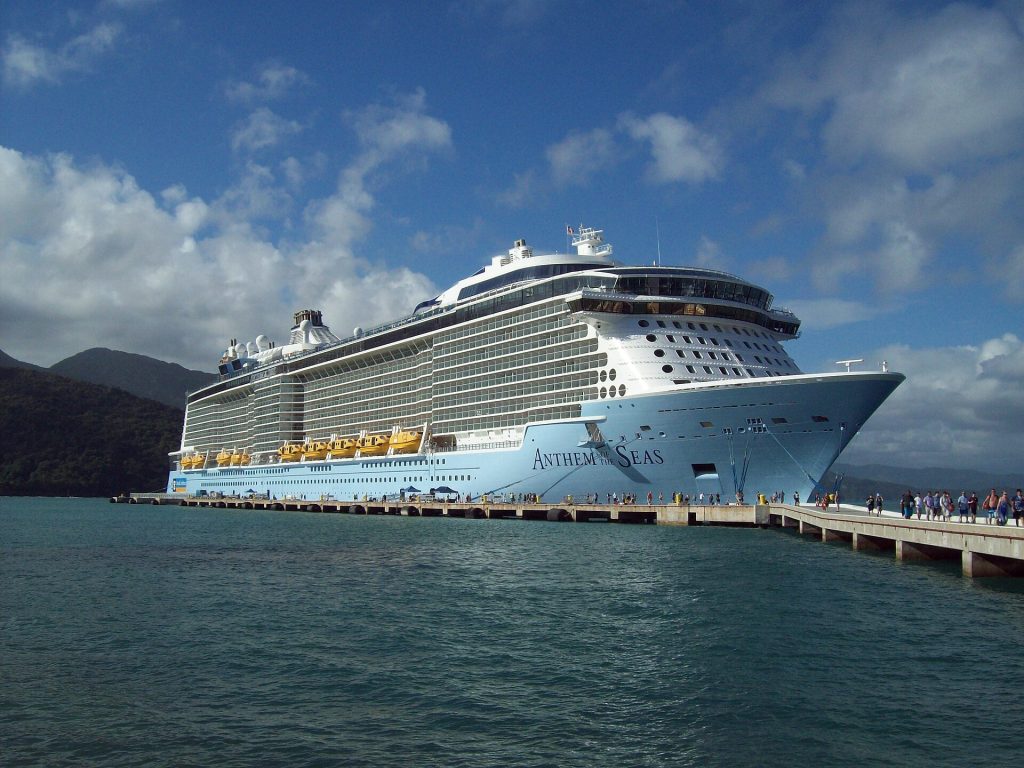
In Eden, the cruise ship Anthem of the Seas sat offshore with propulsion issues. No passengers on board, but around 1,500 crew. There was no berth available in Sydney long enough for repairs, so the vessel came south.

Crew members disembarked to walk the streets, buy groceries, sit at cafés. A floating city reduced temporarily to workers at rest.

The scale of it struck the caller. Nearly 5,000 passengers when full. Thousands of staff working below decks. A town of 3,000 hosting a ship built for many times that number.

Blazes and Tenterhooks

Kevin from BlazeAid spoke of eleven blazes across Victoria and New South Wales. Camps near Euroa, Goomalibee, Natimuk and beyond. Fences down for kilometres. Livestock losses mounting.

He recalled 1939, Black Saturday, Ash Wednesday. February has form. The state remains on tenterhooks. Grass waist-high along roadsides. One week of forties and it runs.

Volunteers are still needed. The work is slow, repetitive, necessary.

Smoke in Newcastle and Pines at Risk

From Newcastle came reports of smoke from Port Stephens and the Shortland wetlands. Asthmatics advised to stay indoors. The sky thick and acrid before six in the morning.

Further south, a part-time pine farmer described losing a ten-year plantation near the Longwood fire. Nearly at maturity. A retirement plan turned to blackened trunks. He counted himself lucky. His house survived.

Farming, he said, is long-term. You begin again.

Bathurst Evenings and Herring Island

There were lighter threads. A Festival of Speed in Canberra. Old cars revving at Thoroughbred Park. A sculptor exhibiting on Herring Island in Melbourne’s Yarra River, where few realise an island exists.

At Bathurst, the heat eased as the sun dropped. A stillness settled over the track. The simple relief of evening air after forty degrees.

In Darwin, the monsoon had finally stirred. Gusty storms. Nightcliff foreshore under heavy cloud. Rain as restoration.

Holding It Together

By the time the lines quietened, the country sounded neither panicked nor triumphant. Just occupied. Ski conferences and shark kits. Caves beneath limestone plains. Forty-eight degree paddocks. Cruise ships paused. Blazes smouldering. Junior athletes driving toward possibility.

Australia in February is a collage of temperatures and effort. The conversations are longer when the conditions are harder. The details matter.

And perhaps that is the steadier thing. Not the weather, not the machinery, not even the fires. Just people describing what they see from wherever they stand, trusting someone on the other end of the line to hear it.

Listen to the podcast episode here.

Disclaimer:Australia All Over’ is a program produced and broadcast by the ABC Local Radio Network and hosted by Ian McNamara. Brisbane Suburbs Online News has no affiliation with Ian McNamara, the ABC, or the ‘Australia All Over’ program. This weekly review is an independent summary based on publicly available episodes. All original content and recordings remain the property of the ABC. Our summaries are written in our own words and are intended for commentary and review purposes only. Readers can listen to the full episodes via the official ABC platforms.

The December 14 Show

A Country Holding Its Breath Before Christmas


By mid-December, Australia sounds slightly different. The year is almost spent. People are tired, reflective, sometimes brittle, sometimes generous. Roads are busier. Conversations wander. And when the phone lines open on a Sunday morning, what comes through isn’t news so much as a collective exhale — stories of work done, journeys underway, and lives paused briefly before Christmas arrives.

Downham Farm and a Landscape That Carries Memory


Kevin rang from the Darling River, travelling between Wentworth and Thurungully, heading toward Downham Farm — land he and his partner bought at the end of the millennium drought. At the time, it was bare earth and dust. Then came rain for a year. Then a flood on a scale not seen since 1956. More recently, a cyclone tore the roof from the homestead he had carefully restored.

Still, Kevin spoke with wonder rather than defeat. The property carries Aboriginal markings, old Cobb & Co crossing points, and places where paddle steamers once tied up along the river. It is land layered with history. Even after fire, flood and wind, he said, it still feels singular. Worth the effort. Worth beginning again.

Kangaroos on the Road and Signs of a Big Season


As Kevin drove the back roads near Bourke and followed long stretches of the Darling, he began to notice how crowded the country felt. Kangaroos everywhere — standing in mobs at dawn, lifting their heads from the scrub as vehicles passed, scattered thickly along the road verges. Foxes darted across the headlights. Feral pigs left their marks in damp ground. Feral cats too, harder to spot, but unmistakable once you’ve learned to see them.

Among them were albino kangaroos — rare enough to make you slow down and look twice. Kevin mentioned the old bush belief that seeing them means a big season is coming, that numbers are building and the land is preparing to surge again. Whether that’s superstition or simply the long memory of people who watch country closely is hard to say.

What was clear was the pattern itself. After drought, flood and rain, life pushes back quickly. Animals respond before people do. They move, breed, spread out. Roads fill up. Collisions increase. The signs arrive quietly at first, noticed only by those who travel the long way through.

It was a reminder that while calendars and forecasts help, the land still speaks for itself — and often well before anyone is ready to listen.

A Twelve-Year-Old on the Way to Cricket

Digby rang next, his voice bright with a mix of nerves and familiarity. He was 12, travelling with his dad from Moree to Gunnedah for a representative cricket match — another early start, another long stretch of road, another oval somewhere beyond the horizon.

He’s a batter, he said, but likes fielding too. He’s already spent years doing this: weekend after weekend in the car, moving between country towns, learning how to wait, how to focus, how to be ready when his moment comes. It’s the quiet apprenticeship of regional sport — kilometres measured as carefully as runs scored.

There was no sense of complaint in his voice. Just acceptance. This is how it works when you love something and live a long way from the centre of things. You travel. You commit. You grow up a little quicker.

Christmas, he said, would be spent at home. After all that driving, it would be nice to stay still for a while.

A Piano, a Mountain, and Carrying Music into the World


Colin rang to update listeners on his nephew, Kelvin Smith — known to many as A Piano of Tasmania. Years ago, Kelvin pushed an upright piano to the summit of kunanyi/Mount Wellington using a specially engineered frame approved by authorities.

Now he is taking a baby grand piano around Australia on a trailer behind his Toyota, stopping at beaches, lookouts, paddocks and ports to play. No ticket sales. No promotion. Just music offered wherever he happens to arrive.

Kelvin later rang in himself, boarding the Spirit of Tasmania and preparing for months on the road. He plays contemporary classical music. He films little. He posts sparingly. He does it, he said simply, because it brings joy.

Work, Strength and the Long View of Ageing

As the program turned inward, Macca reflected with guest Kieran Kelly on ageing, fatigue and the effort required to keep moving well. Kieran spoke about strength training, boxing and Pilates in his seventies — not for appearance, but for function. For independence.

The conversation drifted toward genetics, discipline and the fine line between staying active and knowing when to rest. No prescriptions were offered. Just the shared understanding that ageing looks different for everyone, but stopping altogether rarely helps.

Roads Around Mornington Island


Benny rang from Mornington Island in the Gulf of Carpentaria, where he runs a road crew building proper access around the island for the first time. What were once rough tracks are now forming into gravel roads. Fifteen workers. Many of them young locals.

He spoke about the pride that comes from operating machinery, watching progress take shape, and giving people rhythm and purpose. He flies in and out from the Atherton Tablelands every six to eight weeks. Twins are due next year. Christmas, he said, would be spent at home.

Music Made by Hands, Not Algorithms


Later, a miner named Zac shared music he’d made with friends in Gympie — rough-edged outlaw country, recorded without polish. Songs about work, mateship and life as it is.

The call opened a broader reflection on artificial intelligence and creativity. AI can now generate songs in minutes, mimic voices and styles, even approximate emotion. But what it cannot replicate, callers agreed, is presence — the feeling of someone standing in front of you, imperfect and real.

Gardening in Northland and Finding Calm


Therese rang while tending a vegetable garden in Northland, New Zealand. Cucumbers climbing overnight. Basil thickening by the day. She spoke about the calm that comes from soil and repetition.

She lives in Dungog and runs a café. This Christmas she would be helping her mother-in-law on the farm. The call was unremarkable — and precisely because of that, grounding.

Becoming Australian, One Small Moment at a Time


Several callers reflected on migration and belonging. KJ, who arrived from India decades ago, spoke about becoming Australian not through paperwork, but through small shared experiences — cricket heartbreaks, heatwaves, laughter at the absurd.

Hans, from Germany, described daily walks near Endeavour Hills, photographing kangaroos and echidnas from a respectful distance. “This is their home,” he said. “I’m only the visitor.”

Both spoke with gratitude rather than entitlement. Australia, to them, is something you grow into.

A Burnt Christmas Tree and a Town That Responded


From Kempsey came a small story with a big heart. Sometime in mid-December, the town’s Christmas tree was set alight. By morning, all that remained was a blackened metal frame — a moment that could easily have soured the season.

Instead, locals turned up. Decorations appeared. Handmade ornaments, lights, ribbons, bits of tinsel pulled from sheds and shopfronts. What had been damaged was rebuilt — not perfectly, but together.

By the end of the day, the tree stood again, changed but unmistakably festive. What could have been vandalism became a shared response, a quiet refusal to let one act define the town or the season.

Holding It All Lightly


As the final program of the year wound down, the threads of the morning drew together. Work and travel. Music and memory. Loss, effort and kindness. Calls from paddocks, kitchens, highways and boats, all carrying the same undercurrent.

After a year of conversations, the lesson felt familiar but no less true: meaning doesn’t arrive fully formed. It’s assembled slowly, almost without notice, by ordinary people doing what needs doing and caring where they can.

Making the Year Hold Together


By the time the phones fell quiet, Australia sounded tired but steady. Not perfect. Not united on everything. But still talking. Still listening. Still showing up for one another in small, unremarkable ways.

That, more than anything, is what carried the year to its end — not headlines or noise, not outrage or spectacle, but voices from farms, cricket cars, road crews, kitchens and quiet roads, all helping life hold together just long enough to reach Christmas.

Listen to the podcast episode here.

Disclaimer:Australia All Over’ is a program produced and broadcast by the ABC Local Radio Network and hosted by Ian McNamara. Brisbane Suburbs Online News has no affiliation with Ian McNamara, the ABC, or the ‘Australia All Over’ program. This weekly review is an independent summary based on publicly available episodes. All original content and recordings remain the property of the ABC. Our summaries are written in our own words and are intended for commentary and review purposes only. Readers can listen to the full episodes via the official ABC platforms.
The November 23 Show

Some Sundays start softly, with stories that linger long after the radio is off. A caller in the studio explaining how a single layer of carbon — graphene — might help roads last longer than the people who drive them. A woman from Albany speaking quietly about scattering her father’s ashes along the Rabbit-Proof Fence, fulfilling a promise to a man who had worked that lonely line as a teenager. And a father in Wangaratta saying he’s grateful Australia is finally giving kids a chance to grow up without the weight of social media on their backs. By the time the morning found its rhythm, you could feel how these scattered voices — thoughtful, tender, practical, hopeful — were all part of the same gentle Sunday mood.

Pete Flying Over Lake Eyre

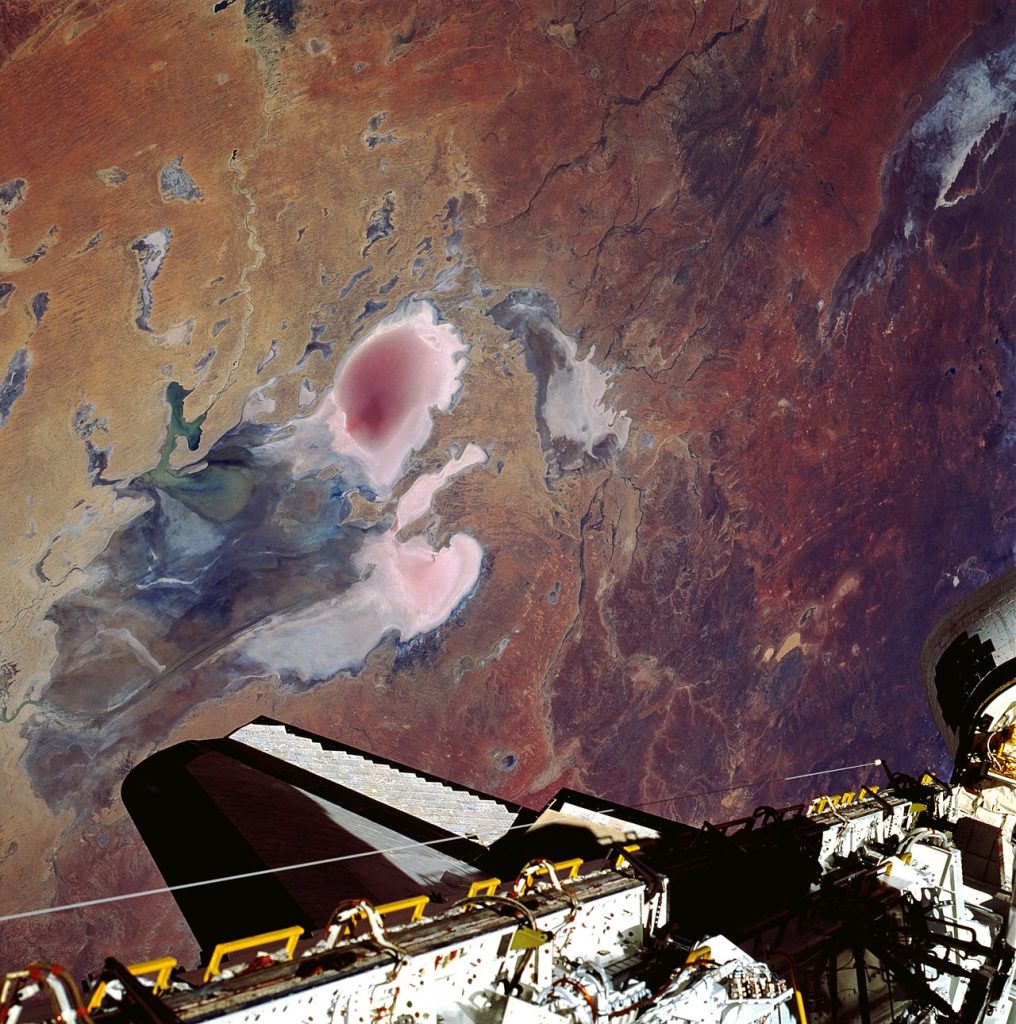
Pete called from the cockpit, still carrying the exhilaration of another flight over Lake Eyre. He has watched the lake shift week by week, and this season has been unlike any he’s seen. “The colours are just incredible,” he said — deep red in Madigan Gulf where Cooper Creek’s fresh water mixed with salt, a green streak in Jackboot Bay, and the surreal blue-green layer in Belt Bay, framed with bright white salt crust. Earlier in the year it was 70 to 75 percent full. Now it’s maybe half, yet still astonishing.

Cool weather lingered longer than usual. “Only had mid-40s once this year,” he said. And with a November cyclone forming near Darwin — the first in fifty years — he laughed gently, “We don’t do averages in Australia. Just droughts, flooding rains and the odd bushfire.”

Photo Credit: NASA/STS-35 

Ed Watching Dawn at Carrickalinga

Ed was looking out over Carrickalinga Bay from a lonely phone box on the Fleurieu Peninsula. “Just wonderful to be alive,” he said, describing the soft orange light behind him. Yesterday brought one of those perfect farmer’s rains — “just drizzled all day” — and it lifted the whole region after a dry stretch.

He spent the afternoon in the shed with the cricket on and the rain pattering on the roof. “I’m retired,” he said, “but I’m busier now than when I was working.” There was a cosy contentment in the way he said it.

Cheryl and the Life Saved at 38,000 Feet

Cheryl wrote in with a story that married skill, timing and a touch of fate. A decade ago, she was a Qantas hostie on a Brisbane–Los Angeles flight when a woman collapsed just before breakfast service. Cheryl had refreshed her CPR not long before. The trainer’s words stuck with her: “Don’t worry about breaking ribs — just save a life.”

“I had carpet burns on my knees to prove it,” she said. The woman had only a one-percent chance of survival. It turned out to be a pulmonary embolism followed by cardiac arrest. She lived, and they’ve remained in touch. On 13 March 2026, that woman will turn 100. “Do that CPR training,” Cheryl urged. “It matters.”

Margaret and the Chilean Sheep-Eating Plant

Margaret from Armstrong near Great Western has been tending three unusual South American plants for twenty years. One of them — a two-metre-high Chilean sheep-eating plant — finally flowered. “We called it the alien,” she said. Its spear shot straight up like a giant asparagus, its long leaves lined with rows of backward-facing spines.

She later learned why shepherds in Chile fear it: sheep can become trapped, die, and nourish the plant. “We’ve got orphan lambs,” she said, half laughing, half worried. “This may not end well.” Macca told her not to let it go to seed. She promised, “Don’t panic, Ian. I’ll be very sensible.”

Val Singing at the Enmore Theatre

Val from Woonona had a voice that carried its own music. She’s nearly 90 and had just sung at the Enmore Theatre with Astrid Jorgensen’s Pub Choir — “two thousand one hundred people!” She has sung all her life, following her mother and sister into choirs.

Astrid organised the crowd into three parts, and while Val is a soprano, she stayed in the mezzo section because “there were too many people to climb over.” She still sings with the U3A choir and had attended a moving concert earlier in the week with the Sydney Male Choir and the Arcadians Lamplighters. One of the Lamplighters was 93. “It brings tears to your eyes,” she said.

Colin and Lily Driving the Monaro

Colin was driving his 1969 HT Monaro to a car show in Geelong with his daughter Lily beside him. The old Holden burbled beneath them as they talked about its rising value. “Eighty to one-fifty, even unrestored,” he said.

“It’s stylish,” he added. “Not comfortable — but stylish.”

He joked about passing Teslas — “They look like wheelie bins.” Lily will inherit the Monaro one day, and you could hear how much that meant to him.

Debbie and the Illegal Tobacco Crisis

Debbie Smith, an independent grocer, called with a sobering report. Tobacco sales in mainstream supermarkets have crashed from around ten percent to as low as two. For independents, the collapse has been catastrophic — some stores dropping from $20,000 a week to $1,700 as illegal tobacco floods the market.

She described criminal syndicates, vanishing tax revenue, menthol cigarettes arriving by the container load, and enforcement tied up in health regulations that require multiple agencies to act together. “We’ve lost billions that should be funding hospitals,” she said. “And smoking rates are going up, not down.”

Chris Weighing Caravans Across NSW

Chris had just finished weighing 37 caravans in Wentworth and Balranald with Transport NSW. “The heaviest was four-hundred-and-fifty kilos overweight,” he said.

People pack caravans like houses — washing machines, extra gear, the comforts of home. “If you want all the comforts of home,” he said, “maybe stay home.”

He’ll be in Mudgee next for another round of free checks. His main message was simple: “Take your time. You’re on holiday. The trucks are working.”

Matthew on Graphene and the Roads of the Future

Sitting in the studio, tech commentator Matthew Dickerson explained graphene — a single layer of carbon atoms arranged like a honeycomb, discovered experimentally in 2004 with sticky tape and graphite. “Two hundred times stronger than steel,” he said.

Mixed into bitumen, it strengthens the binder so roads last longer — two and a half times longer in some trials. “The rocks become the weak part,” he said. They talked AI, potholes, overloaded roads, and the impossible task of maintaining 877,000 kilometres of Australian road with a growing population.

Jim Marking Lambs in Ballarat

Jim rang from Ballarat with the sound of sheep filling the background. They were marking lambs — vaccinating, tagging, checking the season’s survivors — but sixteen wedge-tailed eagles had descended on the lambing paddock.

“They know we’re the last to lamb in the district,” he said. He admired the birds, but the losses hurt. Ravens, crows, foxes, eagles — no easy answers. One by one, the eagles perched on stumps waiting for movement. “Magnificent things,” he said. “Just too many for us this year.”

Betty and the Pianola That Sings Again

Betty from Nunderi sounded delighted. Her 100-year-old pianola had just been restored by her tuner, Jed, who gave it a test run. “He peddled it and sang ‘Some Enchanted Evening’,” she said.

She has a new turntable, vinyl records, cassettes — “everything old is wonderful.” The pianola came from Newcastle forty years ago and still brings joy to visiting children. “Their eyes pop out,” she said. “They can’t believe it plays itself.”

Flynn and Mum After Cyclone Megan

Young Flynn joined the call from the Tiwi Islands after his first cyclone. “Lots of wind and rain,” he said. School was closed and being used as a shelter for people with weaker homes. His mum, Heidi, said the tide surge hit at the same time as the storm passed.
Despite the chaos, Flynn had been fishing for barra, camping and settling into island life. He spoke with the calm resilience kids often have after wild weather.

Yvette, Her Dad, and the Purple Fairlane

Yvette from Jindabyne had lost her father the week before. He was a truckie and listened to Macca every Sunday. “In the purple Fairlane with the white leather seats,” she said. He’d drive with the windows down, no air-con, letting the wind do the cooling.

She used to pick up the CB and sing to the passing truckies. “Your voice was home to him,” she told Macca. She has passed that ritual to her own boys. She also shared pride in her niece, Josie Bath, who is heading to the 2026 Winter Olympics for snowboard cross. “We’ll be there in our pink helmets,” she said.

Lee on Kids, Screens and Real Friendships

Lee from Wangaratta, a father and educator, saw hope in the new laws restricting social media for under-16s. “It’s a chance for real connection,” he said — kids knocking on doors again, talking face-to-face, learning to navigate friendships without the constant pressure of private messaging.

“Technology just went too far,” he said. “This brings balance.” Matthew agreed — saying the change might be one of the best gifts a country can give its young people.

Suzanne at the Rabbit-Proof Fence

Suzanne from Albany, a bird photographer, had been visiting a remote property north of town when she stopped near the Rabbit-Proof Fence. On a gate she found a damp plastic bag tied carefully to the metal. Inside was a handwritten letter — three pages — asking the station owners’ permission to return.

The writer’s father had worked on that stretch of fence at 15 years old. Before he died, he asked that his ashes be scattered there. When the family returned, they placed a small cross on a rise overlooking the fenceline. “It was very moving,” she said quietly — a simple act in a quiet place that carried decades of meaning.


By the time the morning wound down, the callers had woven a picture of the country that felt both familiar and surprising — pilots tracing colour over the desert, singers raising old rooms to life, farmers watching the sky, parents guiding kids into gentler futures, and families honouring memories in far-off corners of the land. It was the kind of Sunday where ordinary people, just by doing what they do, made the whole morning feel quietly extraordinary.

Listen to the podcast episode here.

Disclaimer:Australia All Over’ is a program produced and broadcast by the ABC Local Radio Network and hosted by Ian McNamara. Brisbane Suburbs Online News has no affiliation with Ian McNamara, the ABC, or the ‘Australia All Over’ program. This weekly review is an independent summary based on publicly available episodes. All original content and recordings remain the property of the ABC. Our summaries are written in our own words and are intended for commentary and review purposes only. Readers can listen to the full episodes via the official ABC platforms.

The November 16 Show

Some Sundays start with a smile you didn’t expect. A man from Sydney cheerfully admitting he rang Santa twice last year — just to make sure the number still worked. A 68-year-old who pushed himself through storms and thin air to reach Everest Base Camp, sounding almost surprised at his own courage. And a woman from Victor Harbour who helps feed thousands every month, offering warmth and strawberries in equal measure. Before the morning settled into its rhythm, you could already feel how these voices — hopeful, generous, quietly proud — were shaping the kind of Sunday that stays with you.

Katerina and the Sugar Gliders

Katerina from Shellharbour had just come out of the bush after a 4.30am start. She’d been checking Elliott traps in the Illawarra lowland grassy woodlands, baited with rolled oats, peanut butter and honey. “We have to become nocturnal too,” she said, because every glider must be processed and released before sunrise.

Her team takes tiny ear clippings for genetics, brushes pollen from soft fur to track feeding trees, and studies how habitat fragmentation shapes their movements. “They’re still common,” she said, “but the more broken the landscape, the worse it is for them.” You could almost hear the early-morning damp still clinging to her boots.

Jo and the Storm Near the Sunshine Coast Airport

Jo woke to a yard soaked by a night of “driving rain.” She tipped 80 millimetres from her gauge, one she’s been checking since her farming days. Nearby suburbs had burnt meter boxes and outages from the electrical storm.

Her voice had the calm of someone used to standing outside at first light, tapping the gauge and taking note of what the night decided.

Greg Waiting Out the Weather in Port Victoria

Greg from Port Victoria sounded like a man who has spent a lot of time looking upward lately. Lentils were ready, wheat still a few weeks off, and showers kept interfering. “We won’t be today,” he said.

But his mood lifted when he described Port Victoria’s upcoming 150th celebration in March 2026. Two tall ships — the One and All and the Søren Larsen — will visit for cruises and heritage displays. He spoke with easy hometown pride, as if the whole town was standing a little taller already.

Bill and the European Wasps

Bill from Blackburn remembered watching European wasps sting empregum caterpillars when he was a boy. “Haven’t seen them since the 1960s,” he said.

He told the story of tackling a nest with a torch wrapped in red cellophane so the wasps couldn’t see the light. “Buzzing for a while… and then silence.” A neat little snapshot of backyard problem-solving.

Mario and the Santa Line

Mario called with the joyful energy of someone who genuinely loves Christmas. “Hash 464646,” he said immediately — the number kids can dial from any public phone box to call Santa.

He confessed, laughing, “I rang twice last year myself.” The first time was to check it still worked. The second time, he said, was “just for fun.” He described the surprise of hearing Santa’s voice burst through the receiver in a phone booth on a Sydney street, catching him off guard like he was eight years old again.

Mario also spoke about Sydney’s Gadigal Station being named the world’s best-designed station by a French architectural institute. “They said it was something out of this world,” he said with pride, as if the win belonged to everyone who has ever changed trains there.
The whole call brimmed with warm enthusiasm — the kind of moment only radio can catch.

Ian at the Eye Doctors Conference

Ian was in Melbourne for an eye specialists conference and planned to head to Torquay afterward. “Dip my toes in at Bells Beach,” he said, ready for the cold.

He spoke about macular degeneration — “family history, ageing, smoking,” he said — still the main risk factors. His voice had that steady clarity that comes from years in a caring profession.

Karen Feeding Thousands in Victor Harbour

Karen from Victor Harbour spoke with gentle firmness about the Three Angels Messages Ministry. “Between four and five thousand people a month,” she said — a number she repeated softly. Students, families, older residents, travellers, people without homes. “We’ve got everyone.”

Everything is free and self-funded. They’re planning to offer hot meals next year. And in the meantime? “We’ve got strawberries in abundance,” she said — vibrant, sweet, locally grown fruit in a time when many need the simple reminder that good things still exist.

Kelvin Sailing Near 1770

Kelvin and his wife were ten kilometres off the coast near 1770 on their 42-foot yacht, sailing south toward Bundaberg with 15 knots behind them.

They’d left Lake Macquarie in winter, explored Cairns, and were cruising home, spotting dolphins, turtles and dugongs gliding alongside. “We absolutely love it,” he said — a man content in the rhythm of sea and wind.

Phil and the 1,200 CPR Students

Phil from Mildura said they had just trained their 1200th CPR student. “Most of them older primary school kids,” he said proudly. Lions Club volunteers had raised the funds through weekend sausage sizzles, and other towns were beginning to adopt the model.

Wally and the Sheepdog That Reappeared in Caloundra

Wally from Borowa told a story with the shape of folklore. A friend’s English sheepdog disappeared and was eventually found months later in Caloundra. “Wouldn’t say anything,” he joked. “Kept it all to himself.”

He also talked about a tough cropping year, hay being a safer bet than grain, and wool needing “another twenty or thirty percent.” His call rambled in that lovely way rural conversations often do.

Grace and Shane at Everest Base Camp

Grace and her husband Shane had just returned from Everest Base Camp, and the altitude was still in her voice. “Five thousand three hundred and sixteen metres,” she said slowly, as if still convincing herself.

They trekked for ten days through wind, rain, storms and the kind of cold that makes your breath feel sharp. “Minus twenty-two degrees,” she said. She described the long switchbacks, the tea houses, the thin air that forced them to take ten steps and rest, ten steps and rest again.

Shane, 68 years old, joined in quietly: “If I can do it, anyone can put it on their list.” He talked about turning a corner one morning and seeing the line of prayer flags fluttering — Base Camp finally in sight. You could hear the wonder in both their voices.

Nathan Searching for Arnie

Nathan’s voice carried a different kind of weight. His German Shepherd, Arnie, was in the back of his Toyota Hilux when the ute was stolen in Wynnum. “I don’t care about the ute,” he said. “I just want my dog back.”

He described the vehicle in detail and said he’d chased countless leads. “I’ve found everyone else’s German Shepherd — except mine.” His hope hadn’t dimmed.

Mick and the Illawarra Convoy

Mick from Wollongong spoke about the Illawarra Convoy rolling down Bulli Pass — trucks polished, rumbling, raising money, with people lining bridges and roadsides to wave them through. “Great turnout,” he said. You could picture it clearly.

Alan Walking From Ballarat to Canberra

Alan was fifty kilometres from Canberra after walking all the way from Ballarat for men’s mental health. “Four pairs of shoes,” he said. He’ll lay a pair for his dad among the 2,500 representing the men and boys lost to suicide last year.

Eldert and the Jacarandas in Adelaide

Eldert from Adelaide talked about jacarandas “going off in a purple haze.” Sometimes there’s even a second bloom in April. He laughed about his unusual name — his daughter keeps finding Eldert Street signs in New York.

Justin Watching Planes at Heathrow

Justin was outside Terminal 4 at Heathrow, “250 metres from the third runway.” Planes roared overhead as he spoke. He’d spent 16 days showing his son around Devon and Cornwall. “Blew his mind,” he said. Storm Claudia had passed through, knocking down a tree in his daughter’s yard, but he sounded energised.

Richard High in Papua New Guinea

Richard called from a goldmine in Papua New Guinea, 2,800 metres above sea level. “One of the best jobs I’ve ever had,” he said. He loves the people, the mountains, and the rugby league culture. “Broncos and Cowboys fans everywhere.”

Gaz Closing Up in Broken Hill

Gaz from Broken Hill had closed his tobacconist after seven years. “Lost seventy-five percent of revenue,” he said, as illegal tobacco surged. He wasn’t angry — just tired and sad about what it meant for the town.

Some Sundays wander from storms to sugar gliders, from Base Camp triumphs to strawberry generosity, from sailing breezes to the simple joy of calling Santa from a phone box. And woven through all of it are the voices of ordinary people, steady and honest, quietly doing the things that make a Sunday feel just a little extraordinary.

Listen to the podcast episode here.

Disclaimer:Australia All Over’ is a program produced and broadcast by the ABC Local Radio Network and hosted by Ian McNamara. Brisbane Suburbs Online News has no affiliation with Ian McNamara, the ABC, or the ‘Australia All Over’ program. This weekly review is an independent summary based on publicly available episodes. All original content and recordings remain the property of the ABC. Our summaries are written in our own words and are intended for commentary and review purposes only. Readers can listen to the full episodes via the official ABC platforms.
The November 9 Show

It opened like a front bar on a Sunday morning: people leaning in, swapping notes about work and weather, prices and patience. From Brisbane’s flight path to snowy Perisher and the salt air at Tathra, the calls piled up into a portrait of Australia right now — inventive, weary, funny, stubborn, hopeful.

“It’s Like a City With No Petrol Stations”

Brendan, under Brisbane’s early-morning freighter traffic, runs a cottage industry with a grand title and a very hands-on reality: boutique spare parts for personal electric vehicles. “About twenty percent goes to the States,” he said — a market that can’t get parts thanks to tariff tangles. “It’s like having a whole lot of cars and no petrol stations.” He does it largely alone: “Had someone last week work one day and never came back.”

Macca riffed on prices doing the long march upward — the $20 litre of oil, the coffee that’s quietly dearer, the grocery total that no longer makes sense. “We’re earning more,” he said, “but the money doesn’t buy nearly as much.”

The Beach That’s Beautiful Until It Isn’t

Down in Loch Sport, Steve had a fisherman’s bulletin from Ninety Mile Beach: spring is the crankiest season — wind, a slick of fine weed that makes casting a farce. His YouTube channel Steve Outside posts a Friday weekend outlook and a Tuesday mid-week update. “If you’re driving two or three hours,” he said, “you’d like to know before you go.” He’s walked other long beaches, too — Eighty Mile Beach in WA — but he knows when to tell people to stay home.

UV Light and Underground Rivers

Jason’s crew had come up from Victoria to reline Ipswich stormwater pipes — 375, 600, 675 millimetre mains. “We pull a fibreglass liner in, inflate it, then cook it with UV,” he said. Rain can stop a whole day’s work. He’s noticed something else: “You don’t see rubbish on the roads up here. In Melbourne, it’s truckloads.” Sunday was the day off: a designated-driver run to Kingaroy with his brothers. Between jobs he hunts for Tillandsias — air plants that cling to trees and power lines, “no soil, no roots,” a small, stubborn kind of magic.

Strawberries Don’t Taste the Same Anymore

A throwaway lament — “Why don’t strawberries taste anymore?” — turned into a proper paddock-to-plate reckoning. Doug Moore, once a Navy clearance diver, grew strawberries through the 1980s. He remembers NSW’s lethal yellow disease and the scramble at the Gosford research station to find clean plant stock. In came selector varieties — including lines imported from South Africa — that solved one problem and created another. “They picked for keeping quality,” Doug said. “Not sweetness.”

That choice echoes down the cold aisle today: big, glossy fruit that can ride a truck and sit in a fridge, but rarely sing on the tongue. Doug’s rule of thumb is old-fashioned and accurate: pick or buy to eat today or tomorrow. Beyond that, you’re bargaining with texture, sugar and scent.

Callers added their fieldcraft. Gail in Melbourne said she watches with her nose: “If you can’t smell it, don’t buy it.” Macca linked it to roses and tomatoes — breed for beauty and travel and you bleed away the thing itself. And later, Rick — a grower straddling the Yarra Valley and Queensland — gave the production view: tunnels and hot houses let you coax softer, sweeter fruit, but outdoor crops often need tougher skins to survive. “Some of the best-tasting varieties are harder to grow,” he said. “Keep buying though — the Victorian season’s on and I need the income.”

The strawberry became a metaphor for half the morning: cost-of-living, trade barriers, design choices that travel well but land thin. What’s the premium now — flavour or logistics?

Hay Like Money in the Bank

On the Fleurieu Peninsula, Taz called between bales: half the usual rainfall, perfectly timed, and the shed is filling fast. “Hay in the hay shed is money in the bank,” he said, channelling his grandfather. At 70, he’s still camp-drafting — “a disease” he laughs — sorting a beast from the mob and running a clover-leaf pattern around pegs in 40 seconds. The family worries. He saddles up anyway. “You only live once, mate.”

Sugar, Flood Debris and a Thin Labour Line

In Ingham, Pino Lenza started at 3 a.m. with daughter Zara and young Preston. The harvester eats cane and, this year, whatever the floods left behind: kegs, pods, 44-gallon drums, timber. Miss a scrap and it jams in the base cutters. He’s short of reliable hands and thinks seasonal workers should have a different tax bracket so they can follow the harvests without getting smashed on PAYG. Costs? “Since COVID, everything just keeps going up — tyres, engine oil, filters, labour.” Sugar prices are ordinary. Break-even is a good week.

White Roofs at Perisher, A Stage at Tathra

Photo Credit: Tathra Hotel

Cliff looked out over Perisher Valley: roofs sugared white after a snap change. After 35 years at The Sundeck — the country’s highest hotel — he’s sold and turned to the coast, where the Tathra Hotel now has a pocket-sized theatre. He invited Macca to play. “I’ve written that down,” Macca said — the kind of promise that turns into a community night within months.

Letters from Everywhere

The inbox sounded like a town meeting: Spotify up to $15.99, Adobe up 11% (“the dollar”), arguments for the old BOM layout at reg.bom.gov.au, and a nod to Weather Chaser founders Kath and Paul Barrett in Frankston for building clearer radar tools when users got lost in the redesign. Brett in SA pointed at the trade shortage: “Why would you do an apprenticeship when you can make $72/hour pulling beers on a public holiday?” Another note listed the four aluminium smelters — Tomago, Bell Bay, Boyne, Portland — just to set the record straight.

The Bells of Remembrance

Noel Bridge wrote from the Hawkesbury, rallying churches — St Matthew’s in Windsor (our oldest Anglican church), Ebenezer Uniting (1809), Windsor, Richmond, Kurrajong Heights — to toll their bells until 10:59 a.m., then fall silent for the 11 a.m. minute. Macca replayed historian Les Carlyon, who gently pressed a truth we often duck: 8,700 Australians died at Gallipoli; over 50,000 fell on the Western Front. If memory were proportional, Remembrance Day might eclipse Anzac Day. But myth, like a strawberry variety, is something we once chose — and now live inside.

“Larry” to Christchurch

Harness-racing lifer Kevin Seymour rang from WA en route to Christchurch. His pacer Leap to Fame — “Larry” — is the richest Australian pacer ever, nudging $4.7 million, eclipsing Blacks A Fake. The New Zealand Cup is two miles at Addington, a 25,000-person day with a field that includes Republican Party, Merlin, and Kingman. There’s even an AI-generated song about Larry by Robert Marshall. “My wife heard it and burst into tears,” Kevin said. The talk slid, as it must, to what AI means for real songwriters — clever tools that remix the world, and the uneasy theft some artists feel.

Guitars, Break-ins and the Line in the Sand

Nigel Foote came down from Blackheath with two Martin guitars and a story: a dawn break-in, a Holden Commodore with “GUITAR” plates gone in seconds, the keys later found in another stolen car. The cop’s bleak comfort: Commodores are theft magnets now that Holden’s closed and parts are scarce. Nigel played “Both Sides Now” like a benediction anyway — proof that one thing AI still can’t counterfeit is the air moving in a room when a human hand makes a string sing.

A caller named Susan said it plainly: “What AI does is steal from every artist’s life’s work.” Macca’s line in the sand was simple: live. Be in the room. Know it’s real.

Ordinary Sunday Doing Extraordinary Things

A ten-year-old named Ily from Mansfield — a student at Mansfield Steiner School — tucked a phone under her mum Fenella’s elbow and played “Down by the Sally Gardens” on the violin. She busks sometimes and once made $102 in a session. Asked why she plays, she shrugged through the line: “I just do it for fun.”

And there it was again — the strawberry test for everything: if you can smell it, it’s worth taking home; if you can hear it in the room, it’s worth remembering.

Listen to the podcast episode here.

Disclaimer:Australia All Over’ is a program produced and broadcast by the ABC Local Radio Network and hosted by Ian McNamara. Brisbane Suburbs Online News has no affiliation with Ian McNamara, the ABC, or the ‘Australia All Over’ program. This weekly review is an independent summary based on publicly available episodes. All original content and recordings remain the property of the ABC. Our summaries are written in our own words and are intended for commentary and review purposes only. Readers can listen to the full episodes via the official ABC platforms.
The Nov 2 Show

It was another Sunday stitched together the Macca way — easy, curious, and full of life. From Nhulunbuy’s tropical edge to the cool valleys of Yackandandah and the wheat fields of Brookton, callers chimed in with stories of travel, work, music and memory. There were yarns about old cars and missing church bells, about vineyards, fiddles and faraway cemeteries, all bound by the familiar warmth of voices meeting in the early morning.

Dave from Nhulunbuy

The morning began in Arnhem Land, where Dave Mitchell rang from Nhulunbuy to talk about jobs and the future of local industry. “I just wanted to say hello to our friends at Tomago Aluminium Smelter,” he said, lamenting the loss of Australian manufacturing as overseas ownership grows. Macca listened as Dave traced how decisions at the top can ripple through small communities: “Unless we start to look after ourselves a bit better, our grandchildren are going to really suffer.”

Their chat drifted, as Macca’s often do, from heavy themes to lighter ones. Dave reminisced about a young singer Macca once played on air — “You warned us she was unusual, but gee she was enjoyable” — and how musical careers can flare and fade quickly. They laughed about meeting performers in Tamworth and then moved on to Dave’s pride in local success stories. “We’re still rocking along up here with King Stingray,” he said. “They’ve gone from strength to strength.”

Before hanging up, Dave thanked Macca’s unseen crew: “They’re a well-oiled single-sail machine.” He also recalled Macca’s visit to Nhulunbuy back in 1999, when he’d kept a copy of The Yackandanda Panda poem from that trip — a reminder of how long these Sunday voices have been crossing paths.

Andrew from Congarinni

Further south, Andrew was up before dawn shifting cattle near Congarinni, west of Macksville, after returning from Europe. He’d spent time in Normandy, where a visit to an American war cemetery left a deep impression. “It was absolutely stunning, very solemn,” he said. “You can’t turn your back on history — what they achieved over there was incredible.”

He and Macca talked about unity and disunity in the modern world and how Europe still carries the echoes of its past. The tone then lightened when Andrew confessed to a recent “pathetic” motorbike spill near Menindee. A patch of bulldust sent him airborne, and he ended up thanking the “lovely nurses at Menindee District Hospital” and the Royal Flying Doctor Service for piecing him back together.

Ernest on the Newell Highway

Cruising between Jerilderie and Narrandera, Ernest was towing a vintage Alvis car — “A-L-V-I-S, built in Coventry” — and revelling in the quiet of the Newell. “After Spain’s mountain passes and endless roundabouts, it’s lovely driving here,” he said. He’d just finished a touring rally through the Pyrenees and felt grateful to be home, where the horizon stretches “to ground and sky and nothing in between.”

Dennis Jagmic in Perth

Macca’s conversation with Dennis Jagmic stretched longer, the tone that of two old hands swapping stories over the vineyard fence. Jagmic, now a Swan Valley vigneron and accountant, once kept wicket for Western Australia and South Australia during the 1970s. “We were amateurs back then,” he said. “Forty-five dollars for a Shield game — four days’ work — but we loved it.”

He grew up across from Houghton Vineyard, playing backyard cricket with Tony Mann, who would go on to play Test cricket. Later, Jagmic found himself second in line behind Rod Marsh. “Everyone said, you’re wasting your time here, so I went east,” he recalled. After a stint in Adelaide under Ian Chappell’s captaincy, he still rates Chappell “number one — a man’s man, hard but fair.”

These days, his challenges come from a different field. “The wine industry’s had a wild ride,” he said, citing export troubles with China and rising production costs. “I’ve got people from the Pacific Islands working for me now — locals just don’t seem to want to do the manual stuff.” He worries that schools push university over trade and that “determination counts more than a degree.” For Jagmic, whether in cricket or on the vines, “you’ve got to have it in the heart.”

Tricia Flannery of Mangrove Mountain

Children’s author Tricia Flannery started writing during the pandemic, drawing inspiration from the casuarinas on her 70-acre property at Mangrove Mountain. Her self-published series The Adventures of the She-Oak Critters uses real photographs of local flora and fauna. “It’s all Australian,” she said. “I refuse to have them printed overseas.”

Photo Credit: She Oak Critters

She writes for children aged four to ten, encouraging them to look up from screens and into the bush. “So much out there is cartoonish,” she said. “I wanted something real — where they sit around the fire and look at the stars.” Her next book will take the critters from country to city, sailing down the Hawkesbury to the Harbour Bridge. “The bush is spiritual,” she added. “It’s peaceful. Friends come here and feel it straight away.”

Peter Denahy from Yackandandah

Peter Denahy checked in from Yackandandah, still bleary after a U.S. trip. “I lost a day on the way back — the universe owes me October 31,” he joked. He’d spent weeks performing around Tennessee and North Carolina under a new entertainer’s visa, playing Nashville’s legendary Station Inn thanks to Kristy Cox and The French Family Band.

He met bluegrass icons like Larry Cordle, writer of Highway 40 Blues, and James Monroe, son of Bill Monroe. “The musicians are phenomenal,” he said. “Kids over there play fiddle like pros.” For Denahy, the trip was a reminder of why he plays: “It puts a firecracker under you — you come home wanting to write.”

He’ll soon appear at Majors Creek Festival near Canberra and later at the Yackandandah Folk Festival. “They got the songs and the humour,” he laughed. “I just had to explain the word ‘dunny’.”

Jean from Paterson (near Gympie)

Jean Davis, 80, rang to help listeners navigate the Bureau of Meteorology’s redesigned website. “You can still get the old one,” she said cheerfully, giving the link reg.bom.gov.au. The new site, she complained, “took away all the town names.” Macca agreed that sometimes “change for the sake of change” leaves people worse off. Jean hoped that if enough users went back, “they might be wary about turning it off.”

KJ in Blackburn South

Among the most heartfelt calls came from KJ, walking through the early sun in Blackburn South. He arrived from India in 1993, after years working in oil and gas. “Slowly you change and become Australian,” he said. “My heart says this is where I live.”

KJ described the courtesy and openness he’d found in Melbourne, contrasting it with a recent tram encounter where someone told him to “go back.” His calm reply: “This is my country. I’m here.” He spoke too about rapid immigration growth and the importance of balance — “Criticize the policy, not the people.”

Macca called him “my Australian of the Year,” saying KJ’s story captured the essence of belonging. “We’re all Australian-made,” Macca said, echoing the old song.

Tim from Mollymook

Driving home from Kangaroo Valley, Tim smiled about an evening spent playing cards with his grandchildren. “These kids don’t use devices,” he said. “They made up a game with three cards in five minutes.” For him, a deck of cards teaches imagination, patience and arithmetic — “a one-stop shop.” Macca agreed: small games, big lessons.

Cheryl from the Blue Mountains

Long-time racing fan Cheryl called ahead of Melbourne Cup Day, relishing the theatre of it all. A former costume-maker, she loves “the whole spectacle” but treats it like a science. “You whittle them down — horses that don’t stay 2,500 metres can’t win,” she said. She praised jockeys Jamie Kah and Rachel King and promised to study the form once the weather settled.

Cara in the Hunter Valley

Cara, once from St Kilda and now in the Hunter Valley, phoned with her Cup tips and a memory of saving a stranded Christmas beetle — “fed her up for nine days and let her go.” Expecting a wet track, she fancied Flatten the Curve, winner of the Bowling Green Gold Cup in Kentucky, and Half Yours, ridden by Jamie Kah. “It’s the race that stops the nation,” she said. “Everyone comes together for it.”

Brian on Bribie Island

Brian remembered attending the 1971 Melbourne Cup with friends, carrying eskies of champagne, beer and Kentucky Fried Chicken straight onto the lawn. At the time, he was working on the tunnel under Arthur’s Seat for the Melbourne Sewerage Scheme. “We just spread out rugs in front of the main stand — you couldn’t do that now,” he laughed.
He’s lived on Bribie Island for nearly 30 years and still loves a flutter. This year he’s backing Absurd. “I came over from New Zealand, sold everything, and never looked back.”

Jan from Brookton, WA

In Brookton, Jan reported a strange theft: both the Anglican and Catholic church bells had vanished. “The Anglican bell had hung there 130 years,” she said. “The Catholic one for 70.” Fearing they’d been stolen for scrap, she appealed for their return. Macca mentioned Peter Olds’ foundry in Maryborough, one of the few places still casting new bells, but Jan said that wasn’t the point — “They were gifts to the community.”

Richard on the Road to Melbourne

Truck driver Richard was hauling two huge tractors south from Far North Queensland. “It’s lush up here,” he said, after chatting with cheerful service-station staff that morning. He noted that Australia’s population had grown by 1.25 million in two years, then joked that many were now living on wheels: “We’re not house-os or wheel-os — we’re wheelies living in our bloody vehicles.”

Richard also carted vintage Studebaker army trucks built under the 1945 Lend-Lease Program, and finished his call with a grin about a lucky $61 bet that came good at the marina bar.

Joan from Skye

The last call of the show came from Joan in Skye, still glowing from Derby Day at Flemington. “The fashions were beautiful — lots of black and white,” she said. She’d met Michelle Payne — “a beautiful young woman” — and watched Pride of Jenny win by ten lengths. “Sometimes I just make up my mind and go,” she laughed. “The roses, the weather, the people — it’s wonderful.”

Ordinary Sunday Doing Extraordinary Things

From Nhulunbuy’s red earth to Brookton’s wheat fields, from Yackandandah’s fiddles to a truck stop near Hay, the voices on Macca’s show carried the sound of a country still connected by conversation. These callers spoke of work and weather, of bells gone missing and beetles saved, of old cars and new songs, of belonging and gratitude.

What ties them together isn’t distance or background but attitude — that easy warmth that starts with “G’day.” Week after week, Australia All Over reminds us that ordinary people, simply telling their stories, make the nation extraordinary.

Listen to the podcast episode here.

Disclaimer:Australia All Over’ is a program produced and broadcast by the ABC Local Radio Network and hosted by Ian McNamara. Brisbane Suburbs Online News has no affiliation with Ian McNamara, the ABC, or the ‘Australia All Over’ program. This weekly review is an independent summary based on publicly available episodes. All original content and recordings remain the property of the ABC. Our summaries are written in our own words and are intended for commentary and review purposes only. Readers can listen to the full episodes via the official ABC platforms.
The Oct 19 Show

It was the kind of Sunday that only Macca could conjure — a cross-country chorus of voices, stitched together by warmth, wit and a weather report or two. From the sunny banks of the Noosa River to calls from Vietnam, the morning rippled with stories of horses, bells, buffalo, fiddle tunes and quiet acts of generosity.

Horses, Hopes and 100-to-1 Chances

The day began on the grass at Noosaville, where Macca met Deb from Bellye Park and her red cattle dog, Chilly. Deb spoke fondly of the thoroughbreds she still tends on her farm, saying that when one dies she digs a big hole and plants a tree over it — a living memorial in the paddock. The talk drifted naturally to the Caulfield Cup. Macca had thrown ten dollars on a roughie at a hundred-to-one that almost came through, and they shared a laugh about the joy of a flutter when fate smiles. Deb, who grew up on a stud with the Freedman boys, reckoned the thrill of racing isn’t about favourites at all — it’s about heart, luck and the stories that stay with you.

The Bell That Rang Again

A few minutes later the conversation turned from horses to hand-bells. Bell-maker Peter Oz had restored a cracked ship’s bell, and when he struck the new casting a visitor cried. “A good casting’s as sound as a bell,” Peter told Macca — a line that felt like a proverb for craftsmanship and care. In that clear tone, Macca heard the echo of security once offered to sailors far from home.

Little Miss — Big Stories

Then came a call from Melbourne and a voice brimming with pride. Filmmaker Angelo reported that Signorinella (Little Miss), his documentary on Italian migrant women, had secured a national cinema release. He spoke of his mother, a seamstress at thirteen, who dared to tell her boss she deserved an adult’s wage, and of women such as Carla Zampatti and Tina Arena whose success grew from the same grit. The film, he said, honoured “the unsung heroes who came here with no language, no safety net — just determination.” Macca agreed that migration is stitched into Australia’s DNA. As they talked, Angelo reflected on prejudice, persistence and the patience it takes for a culture to make room. “Everybody just wants a better life for their kids,” he said. “Give them time to show what they bring.” It was one of the morning’s longer conversations — warm, thoughtful and deeply Australian.

Buffalo at Maleny

Back in the park, mother-and-daughter team Margaret Thompson and Steph described running Queensland’s only buffalo dairy on the hills near Maleny. Dairy deregulation had pushed them to rethink everything, so a spontaneous cheap flight to Darwin became a $20 000 plunge into buffalo farming. Their Mediterranean-bloodline herd now produces rich, low-cholesterol milk for boutique cheesemakers from Byron Bay and Brisbane to Sydney. The animals, they said, are docile as long as you keep the bad-tempered ones out of the gene pool. Their laughter carried across the crowd — proof that innovation in farming still begins with a leap of faith and a good sense of humour.

Greg the Dentist — Forty-Eight Years Bent Over

Among the listeners sat Greg, a dentist from the Gold Coast who has rung Macca for decades. After forty-eight years bent over patients, he’s ready to hang up the drill. “That’s a long time to be hunched over,” he said, rubbing his neck with a grin. He’s watched the trade shift from handmade crowns to computer-milled precision and marvels at how expectations have changed. Macca reminded him of old-timers who’d told stories about brides having their teeth out before marriage — a strange ritual from a world that no longer exists. They laughed, grateful for progress and for the lightness that comes when you can finally straighten your back.

Fiddles, AI and Singing Mushrooms

Later, fiddler Phoebe called in with a yarn from a gig that went sideways. The lead singer, she said, kept insisting he’d written thousands of songs — “all in the key of Steve.” Every one sounded the same. She and Macca riffed about the flood of AI-generated music and even a study claiming mushrooms could make melodies through their electrical pulses. “The mushrooms are making a song,” Phoebe insisted. Macca laughed, half-believing her, half-delighted by the idea that creativity sprouts wherever curiosity does.

Skies Wide Open

Under the All Over News banner, Macca crossed to Perth pilot and teacher Graham McGinn, who said the aviation industry was taking off again. Airlines, he explained, were desperate for trained staff, from engineers to flight instructors. The trick, he said, was “stickability” — the discipline to hold an aircraft steady and the persistence to stay the course through lean years. It’s a lesson, Macca noted, that fits almost any trade in Australia today.

Spud’s Garden and the Music of Birds

From planes to plants, the next voice belonged to gardener Spud Carroll in Western Australia’s hills. He compared the east’s fussy waratahs with the west’s hardy kangaroo paws and described a landscape so diverse that a single kilometre in the Darling Range hosts more species than the whole of the UK. He spoke tenderly about magpies, butcherbirds and cuckoos, the bush alive with music. “It’s all about observing,” he told Macca. “You learn something new every day.” They lingered on that thought — the patience of gardeners and radio hosts alike, both listening for what blooms next. For Spud, the bush is teacher, workplace and orchestra all at once.

Diving Into Another World

Back by the river, English-born Richard from Narangba had come after a scuba trip was cancelled. He told Macca he’d rediscovered diving after decades away and now spends weekends exploring reefs and the scuttled HMAS Brisbane. “You look underneath and there’s a whole new world,” he said. “And no TikTok down there.” “Or Macca,” came the reply, “blessed relief.” The exchange was quick but memorable — a reminder that wonder often hides just beneath the surface.

Maureen and Mike’s Heliconias

Long-time Noosa market growers Maureen and Mike brightened the stage with talk of their heliconias and gingers — tropical exotics they’ve cultivated for decades. Their flowers have taken them to conferences in Panama, Colombia and India, yet it’s the early-morning regulars at the markets they cherish most. Retirement, they laughed, is only half-retirement when you still have fifteen acres and a lifetime habit of nurturing things.

Those Folk from Gympie

The morning found its rhythm again when Claire and Lawrence, the Americana duo Those Folk, took up guitar and mandolin. They met at a Scottish festival, fell in love and now call Gympie home. Their song about springtime in south-east Queensland drifted out across the Noosa River, harmonies rising like sunlight through trees — a small concert in a park that felt like the heart of Australia All Over.

A Maestro Remembered

From Sydney, Vicki Tico phoned to talk about Tico Beyond the Baton, the new documentary on her father, conductor Tommy Tycho. She recalled how he arrived in the 1950s with nothing and went on to orchestrate the national anthem and accompany many of the nation’s greats. Macca remembered hearing Tycho’s arrangements for Mary Schneider’s Yodelling the Classics and mused that migration and music share the same rhythm — people bringing their sound and their soul to new shores.

Bread, Bills and the Cost of Living

The tone shifted when bakery owners Peter and Jocelyn from the Sunshine Coast spoke about running a small business in tough times. Staffing, red tape and rising prices, they said, have worn people thin. “Everyone thinks it’s easy — open your doors and make money. It’s not.” Macca agreed that the official inflation figures don’t match what families feel at the checkout. It was a grounded chat — real, relatable and just a bit exasperated — before the show turned to something gentler.

Therapy Dogs and Quiet Lessons

Christian and Kerry arrived with their dogs Bear and Kelvie, therapy companions who visit aged-care homes. Kerry said Kelvie always seems to know who needs him most, curling up beside lonely residents until a smile returns. Watching them work, she’s learned a kind of forgiveness. “They have a blue, then two minutes later they’re playing again,” Christian said. Macca nodded: lessons in loyalty and letting go, straight from four-legged teachers.

Fraser and Baby Maggie

A few metres away sat Fraser, a form-worker from Torquay, cradling five-month-old Maggie while his ranger partner fetched a hat. He spoke about concrete work, Queensland humidity and the novelty of hearing the show live. Macca joked that Maggie might be his youngest listener yet — a quick, sweet moment that said as much about continuity as any sermon.

Mike McClellan’s Last Long Tour

As the sun climbed, singer-songwriter Mike McClellan took the stage to announce that, at eighty, he’s embarking on his final long tour. He still finger-picks with the finesse that made his name and is finishing both a memoir and an acoustic album. “I’m lucky,” he told Macca. “The voice still works, the fingers still work.” The two musicians swapped thoughts on practice, pain and the persistence that keeps art alive long after fashion fades.

Four Women, One Bike

Teacher Rachel Beaton rolled in next with a tale that made the crowd cheer. She and three friends had just pedalled a four-person tandem from Perth to Sydney — 4 000 kilometres — raising funds for Gotcha for Life. “Everyone we met said, ‘We heard you on Macca!’” she laughed. Their journey across the Nullarbor was equal parts endurance and joy, the perfect embodiment of the community Macca builds each week.

From Mayor to Musician

Photo Credit: Heritage Noosa

Then came Bob Abbot, once Noosa’s long-serving mayor, now happier to be known as a muso. He reminisced about three decades of local government and his pride in protecting the riverfront where they stood. “I used to tell people I lived two streets up from God,” he said with a grin before lifting his harmonica to play. The tune was rough, real and full of life — exactly like the town he once led.

Giving Back from Hoi An

The final call of the morning came from Peter Quinn, father of Claire from Those Folk, phoning from Hoi An in Vietnam. A retired teacher, he volunteers with a Brisbane-based charity supporting disabled children. “When you give here,” he said, “every little thing is appreciated — it gives you purpose.” His words, floating halfway across the world, brought the program home to its heart: kindness, connection and the quiet satisfaction of doing good work.

Ordinary Sunday Doing Extraordinary Things

By the time Macca signed off, the crowd by the river had swelled, the sun was high and the mood easy. From racehorses to riverboats, from buffalo dairies to dive reefs, it had been a morning of ordinary Australians doing extraordinary things — proof that a Sunday shared in conversation can make a country sing.

Listen to the podcast episode here.

Disclaimer: ‘Australia All Over’ is a program produced and broadcast by the ABC Local Radio Network and hosted by Ian McNamara. Brisbane Suburbs Online News has no affiliation with Ian McNamara, the ABC, or the ‘Australia All Over’ program. This weekly review is an independent summary based on publicly available podcast transcripts and episodes. All original content and recordings remain the property of the ABC. Our summaries are written in our own words and are intended for commentary and review purposes only. Readers can listen to the full episodes via the official ABC platforms.

The Oct 12 Show

It was the kind of Sunday that only Macca could conjure — a cross-country chorus of voices, stitched together by warmth, wit, and a weather report or two. From foggy Bemboka to sun-washed Esperance, truckies, farmers, and flyers rang in to share their patch of the world. What unfolded was a morning of stories about endurance, kindness, and that unmistakable Australian mix of humour and heart.

Ian from Bemboka – The Road That Never Ends

The first voice of the morning was Ian’s, steady as the diesel hum behind him. He was somewhere between Goulburn and Hay, hauling bricks to Adelaide, when he called through the crackle. From Bemboka, near Bega, he described the fog and the way frost clung to the edge of the road. “Bit of a white one, mate — you could hang your breath on the mirror,” he said. He’d left at three a.m. and told Macca that he liked those dark hours when the world is half-asleep. They talked about the life of long-haul drivers — servo bacon rolls, half-finished coffees, and the comfort of the road’s rhythm. Ian admitted he sometimes pulls over just to listen to the dawn chorus. “Magpies don’t care if you’re late,” he said with a grin you could hear down the line. For a while the two compared favourite routes and truck-stop characters before Ian signed off to keep the wheels turning. “You keep us moving, mate,” Macca said. “Someone’s got to,” Ian replied, and the laugh that followed sounded like gravel under tyres.

Mitch and Roy from Kalbarri – Fences, Floods and Family Humour

A burst of static, then Mitch came through from Kalbarri with his son Roy chiming in from somewhere nearby. “Lost the gate in that last blow,” Mitch said. “Found it two paddocks over,” Roy added, setting both of them laughing. They’d spent the week wrestling with twisted wire and a restless flock after storms had torn through their place. Macca joined the fun, teasing that Roy ought to be on wages. “He’s on one — it’s called dinner,” Mitch shot back. The conversation bounced from weather to wool prices to a story about a neighbour’s sheepdog that chased a fence panel clear across the yard. Between jokes, Mitch talked about how hard seasons test patience and how families hold farms together. “You’ve just got to keep showing up,” he said. Before hanging up, Roy shouted, “Tell everyone Kalbarri’s still standing!” “And laughing,” Macca added, still chuckling as the line dropped.

Danny in Melbourne – Waiting Rooms and Resilience

Danny’s call slowed the tempo. He was phoning from Melbourne, his voice quiet but clear. He’d spent time in hospitals recently and wanted to talk about waiting — not the inconvenience, but the humanity in it. “You see people who’ve been there longer than you, still smiling,” he said. He spoke about strangers sharing sandwiches, nurses who remember names, and the way small talk becomes a lifeline. Macca, listening intently, said, “That’s courage too, mate.” Danny agreed, adding that real strength isn’t loud. “Sometimes it’s just keeping your seat while the hours crawl.” The conversation ended softly, leaving a pause that seemed to linger through the next song.

Photo Credit: Royal Melbourne Hospital

Clarky from Cambelligo – Wires, Dust and Bush Ingenuity

Somewhere outside Cobar, Clarky was knee-deep in red dust, elbows in a Telstra phone box that had stopped working weeks ago. “You wouldn’t believe what’s in here — ants, dirt, someone’s old lunch,” he told Macca between bursts of static. “Dust gets in everything out here — even the bread.” He works out at the Mount Poppy Gold Mine and said the phone box is their line to the rest of the world. “When it dies, the fellas reckon civilisation’s over.” Macca laughed as Clarky described cleaning the terminals with a toothbrush and coaxing a faint dial tone back to life. “Got her singing again,” he said, and behind him came the sound of miners cheering. “Telstra should give you a medal,” Macca told him. “Just send me a new screwdriver,” Clarky answered. They both laughed, and for a moment listeners could almost smell the dust and grease of the outback, where persistence and humour fix everything eventually.

Chris – Between Accents

Chris, a British expat now living in Australia, rang to talk about language. “Back home you say ‘cheers’ for everything,” he said, “but here ‘mate’ does the lot — hello, sorry, even goodbye.” Macca teased that he’d gone native. “I probably have,” Chris said, laughing. They traded examples of how Aussies stretch vowels until they sound like music. Chris confessed he still catches himself using British slang that earns him funny looks at the pub. “You learn fast,” he said, “if you order a ‘pint of bitter’ in Queensland, you’ll just get bitter looks.” Macca roared with laughter. Then Chris turned reflective. “I still miss the rain,” he said, “but I wouldn’t swap this light for anything.” It was one of those small, smiling calls that show belonging is often found in conversation.

Pete from Watheroo – Machines and Miracles

Pete from Watheroo sounded energised by the season. “The crops are a picture, Macca — best I’ve seen in years.” A machinery dealer by trade, he spent most of the chat describing how the new harvesters talk to satellites and to each other, sending yield maps straight to a laptop in the ute. “They’ll tell you moisture, speed, even how level you’re sitting,” he said, “but they can’t tell you when the weather’s about to turn.” Macca asked if he trusted the tech. Pete laughed. “I trust my gut more. You know it’s a good year when you can hear the bins filling before the thunder.” The pride in his voice made it sound like music — steel, rain, and satisfaction blended together.

Watheroo Farm
Photo Credit: Google Maps

Anthony and Catherine from Petrie – The Sunday Market Run

Anthony and Catherine called from the car on their way to the Petrie markets, radio on loud enough for Macca to hear the turn signal clicking. “Not selling, Macca — buying,” Catherine said. “Plants we don’t need.” Anthony laughed that they were “rescuing ferns from neglect.” Macca told them they were single-handedly supporting the nursery industry. The trio chatted about Sunday rituals — coffee, markets, and the small extravagances that make weekends feel earned. Catherine said, “That’s what Sundays are for — spending a little on happiness.” It was a short, sunny exchange that felt like a smile on air.

Ken in Missouri – Flying Far, Listening Home

Half a world away, Ken, an Australian pilot living in Missouri, tuned in before take-off. “Still flying freight across the Midwest,” he said. “Flat country — if you squint, it could be the Nullarbor.” He misses the magpies and the scent of eucalyptus after rain. Every Sunday, before the engines start, he streams the show through his headset. “You’re my bit of home, Macca.” The reply was gentle. “Good to have you aboard, mate.” For a moment, the static between them sounded like wind over open sky, the distance folded small enough to fit inside a radio wave.

Jeff from Palm Beach – A Paddle-Out for Jack McCoy

Jeff rang from Palm Beach, his voice still carrying the hush of the morning. He’d just returned from the paddle-out for surf filmmaker Jack McCoy. “The water was glassy, not a ripple,” he said. “Hundreds out there, boards in a circle, quiet as a church.” He spoke about McCoy’s gift for finding beauty and his generosity toward young surfers. Macca answered softly, “That’s a life well lived.” The silence that followed was brief but full — the sound of listeners remembering someone they might not have known but somehow felt they did.

Rhonda from Esperance – Wildflowers and Wonder

Then came Rhonda from Esperance, her voice bright as the morning she described. “You’ve never seen colour like it, Macca — pink wreath flowers everywhere.” She was calling about the Ravensthorpe Wildflower Show, where tourists lie on the verge to photograph blooms shaped like halos. “We had one couple arguing over which pink was pinker,” she said, laughing. Her family runs a broadacre farm nearby, and she told Macca that after months of dust, the sight of wildflowers lifts everyone. “Even the blokes who never smile start whistling.” They talked about how the show brings the town together, school kids painting signs, locals baking for visitors. “Out here, spring doesn’t arrive,” Rhonda said, “it bursts in.” Macca agreed that Australia could always use more bursts like that.

Alastair Calder from Mildura – Counting Sheep and Sharing Stories

When Alastair Calder from Mildura came on, the pace quickened again. He’d just wrapped the first Sheep Pregnancy Scanners Conference and sounded proud. “We’ve scanned six-point-one million this year,” he said. He explained how scanners use ultrasound now — “From guesswork to heartbeats, that’s the jump we’ve made.” He talked about the camaraderie in a job that keeps you on the road for months, living on thermos tea and roadside lunches. “We might work alone most days, but the community’s real — someone’s always a phone call away.” Macca joked, “That’s a lot of wiggly tails to count.” Alastair laughed and said every lamb’s heartbeat still feels like good news. It was a mix of hard numbers and human warmth — science meeting the paddock with a handshake.

Doctor from Ballina – The Mind’s Gym

The last call of the morning was from a doctor at Ballina Hospital. His voice was calm, reflective. He spoke about mental health in medicine and the need to keep minds fit as well as bodies. “We do all this physical training,” he said, “but the brain needs exercise too — what I call ‘brain gym.’” He explained how laughter, rest, and community can protect doctors from burnout. “We mend others best when we remember to mend ourselves.” Macca paused, then said quietly, “That’s a good note to finish on.” For a heartbeat the air was still — just the faint hiss of the transmitter — before the next song rolled in, soft and slow, carrying the morning away.

Listen to the podcast episode here.

Disclaimer: ‘Australia All Over’ is a program produced and broadcast by the ABC Local Radio Network and hosted by Ian McNamara. Brisbane Suburbs Online News has no affiliation with Ian McNamara, the ABC, or the ‘Australia All Over’ program. This weekly review is an independent summary based on publicly available podcast transcripts and episodes. All original content and recordings remain the property of the ABC. Our summaries are written in our own words and are intended for commentary and review purposes only. Readers can listen to the full episodes via the official ABC platforms.